AI in physiotherapy practice: Clinicians’ voices from Ghana
Authors: Dr Beatrice E A Sankah1,2, Dr Mary Wetani Agoriwo1,3, Adjoa Nkrumah Banson1,3, Dr Cosmos Yarfi1,3, Innocent Edem Fayison1,3, Kweku Nyankonton Asare1,4
1. JBI Evidence-Based Practice Research Group Ghana
2. University of Cape Coast
3. University of Health and Allied Sciences
4. Greater Accra Regional Hospital
Introduction
Artificial intelligence (AI) is increasingly shaping how health information is produced, accessed and used. The World Health Organization’s guidance on AI for health, therefore, emphasises that ethics, human rights and accountability must remain central to AI use in health. In physiotherapy, AI is increasingly being explored for diagnosis, clinical decision-making, patient assessments, patient monitoring and management. While AI may improve the precision and efficiency of care, its use has also raised concerns about errors, data privacy and responsible implementation (Mohapatra et al. 2024). This blog shares the voices and experiences of five physiotherapists practicing in Ghana. Through telephone discussions, brief WhatsApp voice notes and written responses, physiotherapists answered two questions about their experiences of using AI in the clinic and its perceived advantages and disadvantages. Their accounts were anonymised, and all physiotherapists verbally confirmed their consent to be quoted in this blog. In line with the 2026 World Evidence-Based Healthcare Day theme, Evidence and AI: People at the Centre, this blog is focused on ethics, integrity and governance of AI in evidence-based healthcare (EBHC) (Pillar 2).
Voices from the clinic: Physiotherapists’ experiences of using AI
Physiotherapist A
I think AI has altered our practice in quite a number of ways […]. It has made clinical reasoning easier because I can use it as a second check. I can […] ask it to challenge my differential diagnosis or point out things I may have missed. […] But, of course, it doesn’t replace clinical examination or our professional judgement.
Physiotherapist B
I think it (AI) is only a quick fix. It can sometimes be wrong, so you need to read extensively as a clinician.
The above perspectives reflect contrasting clinician experiences. Across the various clinical discussions, experiences with AI ranged from limited use, where some clinicians rarely used AI in the clinic and preferred to consult with experienced colleagues or draw on workshops, to increasingly frequent use. Some described its use as largely positive and could not readily recall a negative experience. At the same time, while AI may strengthen clinical reasoning and provide useful support, some consider it unreliable, and they stressed the need for its outputs’ verification, further reading and professional judgement. Nonetheless, physiotherapists valued AI as an additional check when developing their clinical reasoning and noted that it provides a source of support, particularly for unfamiliar conditions and uncommon clinical presentations.
Despite the differences expressed by the physiotherapists, there was broad agreement that AI should complement rather than replace clinical reasoning, and they recommended that fellow physios take caution with its use in the clinic. In this regard, Ghanaian therapists are not alone in seeing both promise and risk in the use of AI. Colleagues from India and Saudi Arabia have also highlighted its supportive role and the value it offers in saving time in clinical decision-making, while at the same time cautioning about issues of privacy, bias and responsible use.
Regarding its use in the clinic, the physiotherapists in this case used AI to explore diagnoses, make assessments, refine treatment plans, guide exercise prescription and develop patient educational materials. Beyond that, other uses included the preparation of clinical notes, reports and medical letters. For the specific tools used, ChatGPT and Gemini were most frequently mentioned, alongside DeepSeek, Claude and UnderMind AI.
While these experiences revealed the diverse ways in which AI is being used across physiotherapy practice in Ghana, they also highlighted that most therapists used it as a second check or starting point rather than the final decision-maker. Their Ghanaian experiences add important practical insight to the global discourse on AI. From the research to date, we know that AI is increasingly being used in Ghanaian physiotherapy practice, even in settings where digital systems and access to complete patient information remain limited, and where digital patient records are not fully connected across departments within the same facility or between facilities. Consequently, physiotherapists may not have access to a patient’s complete history or details of the care they previously received elsewhere, requiring physiotherapists to rely heavily on the patient’s account, which may be incomplete or inaccurate. This means physiotherapists’ professional judgement, clinical reasoning and careful verification are particularly important for evidence-informed decision-making. For instance, when patients’ records are incomplete, physiotherapists must verify AI outputs against their partial histories, physical examinations and clinical findings, or discuss the outputs with experienced colleagues, before applying their recommendations in clinical practice.
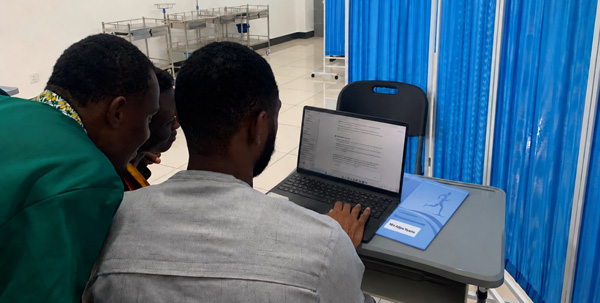
Ghanaian physiotherapists consulting an AI tool in the clinic
Advantages of using AI in the clinic
Ghanaian therapists valued AI mainly for its speed, accessibility and role in supporting their clinical reasoning. Moreover, it provided rapid access to information when they encountered uncommon clinical presentations, as one physio explained: ‘AI can be a starting point for further lines of thinking or discussions’. AI also helped the physiotherapists to explore differential diagnoses and identify clinical possibilities they might have missed. Furthermore, beyond direct patient care, AI supported evidence searching and summarising, organised clinical notes and reports, reduced the documentation time and made communication with patients, health professionals, managers and policymakers easier. These are valuable contributions towards evidence-informed healthcare, because quicker access to information and clearer communication mean evidence is more usable in routine practice.

Ghanaian physiotherapists using an AI tool to explain assessment findings and management options with a patient
Disadvantages of using AI in the clinic
Most clinicians’ main concern was that AI can produce inaccurate or misleading information. One clinician noted, ‘I don’t use it to check research evidence, though; it has been very misleading for me in that area’. Others cautioned that an overreliance on AI could reduce independent thinking, and they recognised that the quality of its responses often depended on the information and prompts provided. Beyond that, AI was changing patient interactions for some clinicians, who described patients arriving at clinics with AI-generated diagnoses and fixed treatment expectations, which required them to address misconceptions and rebuild trust before assessment and management could begin. Other concerns included patient confidentiality, data protection, biases and unreliable references from research enquiries.
These concerns echo those reported by other physiotherapists around patient privacy, ethical responsibility, overreliance on AI and the possible weakening of clinician–patient relationships. In agreement, we highlight the guidance by the Charted Society of Physiotherapy that AI outputs should be checked before use and that therapists must remain accountable for their clinical decisions. In discussions within World Physiotherapy corridors, it is well acknowledged that AI and assistive technologies are already part of physiotherapy practice, but while they can increase efficiency, they cannot replace clinical reasoning or rigour. The recommendation for the global physiotherapy community, now and in the future, is to ensure that the integration of AI into clinical practice is guided by ethics, equity and evidence, not merely efficiency.
Lessons learned
1. Ghanaian physiotherapists’ experiences show that AI’s value depends not only on access to it but also on how responsibly it is used
2. Clear prompts may improve responses, but they do not guarantee accuracy or local relevance. AI should therefore be used as a starting point or second check alongside accurate clinical reasoning, reliable evidence and the local context
3. AI affects more than therapists’ work; it also shapes patients’ expectations and conversations during consultations. Effective use, therefore, requires digital literacy, professional judgement and sensitivity to the realities of the local healthcare context
Key messages and recommendations
1. Physiotherapists and other clinicians must remain accountable for clinical decisions made with AI support. AI should assist professional judgement – rather than replacing it – and its outputs must be verified before use
2. Ghanaian physiotherapists and other healthcare professionals, particularly from lower/middle-income settings, need practical AI training and locally relevant guidance to support the safe and responsible use of AI in clinical settings
In sum, the experiences of Ghanaian physiotherapists expressed in this blog offer a timely reminder that AI may support evidence-informed practice, but people (patients, their carers and the public), professional judgement and accountability must remain central to the clinical decision-making process.
Acknowledgement
The authors thank all Ghanaian physiotherapists who were willing to contribute their experiences during the discussions in the development of this blog.
References
Chartered Society of Physiotherapy. (2025). Artificial Intelligence (AI) principles in action: New AI in physio principles provide a ‘guideline for the future’. https://www.csp.org.uk/professional-clinical/professional-guidance/ai-use-physiotherapy?check_logged_in=1
Mohapatra, A., Mohanty, P., Pattnaik, M., & Padhan, S. (2024). Physiotherapy in the digital age: A narrative review of the paradigm shift driven by the integration of artificial intelligence and machine learning. Physiotherapy – The Journal of Indian Association of Physiotherapists, 18(2), 63–71. https://doi.org/10.4103/pjiap.pjiap_89_24
Shawli, L., Alsobhi, M., Chevidikunnan, M. F., Rosewilliam, S., Basuodan, R., & Khan, F. (2024). Physical therapists’ perceptions and attitudes towards artificial intelligence in healthcare and rehabilitation: A qualitative study. Musculoskeletal Science and Practice, 73, 103152. https://doi.org/10.1016/j.msksp.2024.103152
World Health Organization. (2021). Ethics and governance of artificial intelligence for health. https://www.who.int/publications/i/item/9789240029200
World Physiotherapy. (2025). How AI is reshaping physiotherapy – and how physiotherapy can shape AI. https://world.physio/news/how-ai-reshaping-physiotherapy-and-how-physiotherapy-can-shape-ai
To link to this article - DOI: https://doi.org/10.70253/UGXD4509
Disclaimer
The views expressed in this World EBHC Day Blog, as well as any errors or omissions, are the sole responsibility of the author and do not represent the views of the World EBHC Day Steering Committee, Official Partners or Sponsors; nor does it imply endorsement by the aforementioned parties.