Can artificial intelligence support equitable access to health evidence?
Authors: Dr Lisa Hartling1, Dr Sarah Elliot, Christopher Wan, Lorraine Brown, Dr Shannon Scott
1. University of Alberta
Patients and their families need accurate and reliable health information to make informed decisions for the best health possible. The focus of knowledge mobilisation (KM) is to ensure that evidence is shared with others in meaningful ways that support decision-making. In detail, KM involves sharing, and sometimes co-developing, evidence-based information in understandable and accessible formats, such as plain language summaries, infographics, and videos. While these formats are meant to be accessible, they are often produced only in English and may not be understood by those whose first language is not English. Artificial intelligence (AI) offers an opportunity to efficiently translate KM resources so that they are accessible for different language groups. However, translating health content poses specific challenges – complex terminology, cultural relevance, and legal requirements for clarity, privacy, and safety.
We began a research program to investigate whether AI can be used for language translation of patient/public-facing health information. We approached this research program as we would approach any health intervention – that is, by applying rigorous scientific methods to understand benefits, harms, and acceptability to patients. Further, we involved an interdisciplinary team, including patients and their families (authors CW and LB are co-chairs of the Pediatric Parents' Advisory Group).
First, we performed an environmental scan, which involved looking for existing studies that tested the ability of AI to translate health information into different languages. Specifically, we searched Google Scholar and PubMed for studies that used commercially available AI tools (such as ChatGPT) and tested how well AI could translate written health information for patients or the public. We found 19 studies, which covered a range of clinical topics. All studies translated resources from English to other languages, most commonly Spanish and Chinese. Google Translate and ChatGPT were the most common AI tools used in the studies, with accuracy and errors being the most common outcomes, often assessed by clinical experts. The studies showed mixed results, but the more recent studies supported the use of AI with some warnings. First, they recommended that humans be involved in reviewing or editing anything translated with AI. Second, they suggested caution in ‘high stakes’ situations. Additionally, studies showed that AI performed better at translating some languages (e.g. Spanish) over others (e.g. Arabic). What we found surprising is that only one study evaluated ‘patient-friendliness’ and only two studies evaluated ‘cultural sensitivity’. Furthermore, no studies involved patients or caregivers.
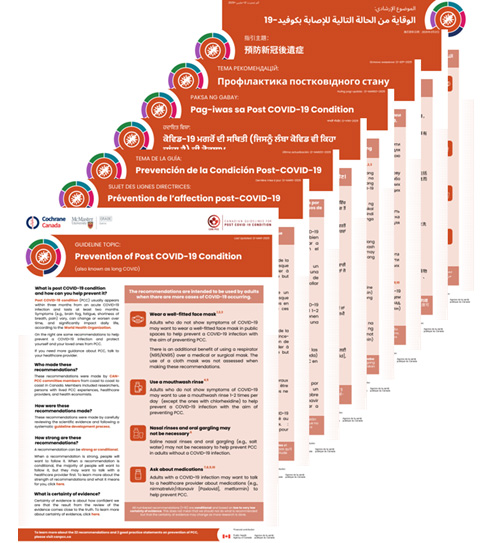
Building on this, we then tested the ability of AI to translate health information by involving the public. With input from patient partners, we designed and conducted a blinded randomised controlled trial to test how well AI could translate a KM resource compared with professional human translators (clinicaltrials.gov, NCT07127887). For this, we used a KM resource that we had created for our national public health agency about the prevention of long COVID (post-COVID condition). This resource had already been professionally translated into seven languages (French, Spanish, Ukrainian, Tagalog, Arabic, Chinese, Punjabi), and we used ChatGPT to translate the resource into the same seven languages. Then, we recruited people whose first language was one of the seven languages in question. We randomised the participants to read either the AI-translated or the professionally translated version in their language. After reading the resource, they answered knowledge questions and rated the resource for readability and acceptability. Overall, 322 people participated, with an average of 46 people per language group. Overall, we found no differences in understanding (knowledge questions), readability, or acceptability. We asked participants if they could guess whether the resource they read had been translated by a professional or AI, and only 46% guessed correctly! We also asked participants if they would trust a resource that they knew had been translated by AI, which produced very mixed results: 64% said they would trust a human translator more, only 3% said they would trust AI more, and 29% said the source of translation does not affect their trust. These mixed results have important implications for using AI to translate and share information with patients and the public: if they do not trust the source (AI), they may dismiss credible evidence-based information, which would negate the efficiencies we hope to gain by using AI.
We are now planning a mixed-methods study to expand our work. We will conduct another blinded randomised controlled trial that will compare an AI vs. professionally translated KM resource. The resource selected for that study is one we previously co-developed with parents about what to expect when taking a child to the emergency department. We will recruit about 600 parents whose first language is Tagalog, Punjabi, Mandarin, or Urdu, which are some of the more commonly spoken languages in our region (other than English). The list also includes high- and low-resource languages – that is, languages with and without large digital datasets for AI learning – which may influence the translation abilities of AI. Study participants will be randomised to view one version of the resource and answer questions about how easy it is to understand and use the information, and how satisfied they are with the resource. After answering the questions, they will be shown the other version of the resource (either AI or professionally translated, blinded to translation source) and asked which one they prefer. We will invite the parents to participate in an interview to gain a better understanding of the reasoning behind their responses and their preferences. This study will provide data and insights into a potentially efficient approach (AI) for scaling KM resources to increase accessibility and address health inequities.
As we are planning this study, we are also undertaking a scoping review of the literature (using JBI methods) to learn from previous research about patients’ and the public’s attitudes, perspectives (including trust), and opinions on the use of AI to access health information and support decision-making. Understanding how patients and the public perceive AI is critical to informing how we use AI in health research, as well as how we communicate about its use and how we ensure the accuracy of information. As with any health intervention, it is essential that patients understand the benefits and harms of AI, and to that end, our work will integrate the best available evidence about patients’ attitudes towards AI with empirical evidence on its effectiveness for language translation. AI may offer an improved approach, in terms of time and costs, for broadly sharing evidence-based health information with different language groups. However, we need to understand its appropriateness, meaningfulness, and effectiveness from patients’ perspectives to ensure the responsible use of AI in evidence-based healthcare.
Key messages:
- Studies examining the applications of AI for language translation of patient/public-facing health information show promise in terms of its accuracy; however, few have involved or investigated the patient’s perspective
- A randomised controlled trial comparing AI-translated and professionally translated versions of a KM resource showed no differences in understanding, readability, or acceptability among 322 participants across seven languages; however, participants expressed mixed views about whether they would trust health information if they knew it had been translated using AI
- Studies examining the use of AI for KM, and in healthcare more generally, must incorporate the patient/public perspective to ensure the acceptability and uptake of AI in this function
References
Canadian Guidelines for Post COVID-19 Condition (2026). Prevention of Post COVID-19 Condition. https://canpcc.ca/resources/resourcesby-topic/#tab-content-prevention
ECHO (2023). What to expect at the emergency department (ED) when your child is sick or injured. https://www.echokt.ca/what-to-expect-at-the-emergency-department-ed/
ECHO (2026). About P-PAG. https://www.echokt.ca/about/ppag/
Elliott, S., Guitard, S., Vandermeer, E., & Hartling, L. (2026). Exploring artificial intelligence systems for language translation of health information: an environmental scan [Preprint]. Preprints.org. https://doi.org/10.20944/preprints202602.1740.v1
To link to this article - DOI: https://doi.org/10.70253/ONVJ1777
Disclaimer
The views expressed in this World EBHC Day Blog, as well as any errors or omissions, are the sole responsibility of the author and do not represent the views of the World EBHC Day Steering Committee, Official Partners or Sponsors; nor does it imply endorsement by the aforementioned parties.