The Unforeseen Partners: AI, Art, Climate Health Science and Community
Author: Faith Agiza1,2
1. Pan African Network for Climate Action fellow
2. African Evidence-based Youth League fellow
I am a health artist, merging art and science. I don’t work in a hospital. My place of work is a sketchbook, a social media page or a hospital wall. My audience is the community. And as part of my job, I can showcase art promoting climate health. Through a fellowship on this topic, courtesy of Nursing Beyond the Books, I gained a deep understanding of the climate health nexus. That’s when my eyes were opened, and I realised that artificial intelligence (AI), art, climate health science and community can co-exist.
Today, heat stress is bringing people discomfort and placing strain on their hearts. Floods are bringing cholera and malaria, and they are displacing people who live in vulnerable areas, such as along riverbanks and in informal settlements. Poor air quality is being linked to wheezing in children. Each of these trends is being driven by changes to the climate, and in one way or another, all of these people end up as patients in need of healthcare. That growing burden places strain on our health resources, and it becomes increasingly difficult to meet the treatment demand.
Yet there’s the possibility of countering this trend. The evidence on climate and health is growing fast, and we have the opportunity to transform that evidence into action. But who is the one translating evidence into something people can see, feel, use and relate with?
Today, AI is transforming how health evidence is produced, shared and used. AI tools can help sort through large volumes of research quickly and output that as a visual aid. They can, for instance, generate a drawing to alert people that they must move from flood-prone areas to safer places prior to El Niño rains, which may arrive in seconds. That is an incredibly valuable intervention, and when we seek to achieve goals such as these, it’s tempting to let AI do all the work.
Yet the benefits of its use come along with certain risks. If we’re not careful, AI will paint over us instead of working with us, as this article will illustrate.
So, AI is powerful, but the choice over how it is applied remains in our hands. In that sense, World EBHC Day’s focus this year on communities, patients and the public as partners feels as though it is personal to me.
Evidence, art and community co-creation
I research, observe and go into the community. Recently, I visited Nairobi’s Eastlands to feel the harsh effects of climate change. Here, there are reports of the effects of heat stress on outdoor workers, dust and vehicle fume smoke triggering sneezing in pedestrians, and children under 5 years old contracting cholera. Simple actions like staying hydrated can reduce the harsh effects of heat stress. Wearing masks while walking along busy roads can reduce exposure to poor-quality air. And treating water, especially during and after floods, can reduce exposure to climate-related diseases, such as cholera.
When I started creating climate health artworks in this setting, I carried out some general research and then got to work. But when I showed my artworks to my mentor, while she complimented them and acknowledged they were indeed relatable, she pointed out that they were not relatable to my target audience, the Nairobi Eastlands community.
AI has been my co-creator, and it gave me inspiration, but its inputs were targeted to Western people. I never noticed that issue until my mentor highlighted it. Out of curiosity, I asked AI to create final artwork, and that’s when I realised AI relates most to Western culture.
Focusing back on poor air quality, this time around, I returned to my research in the context of Nairobi’s Eastlands. I also talked to some people in the community and learned what poor air quality means for them. I learned that they related poor air quality to industrial activities and noted that it affects the environment as well as health.
This experience changed my process. Now, I relate and interact with the community firsthand. Then, I use AI as an assistant, not a fellow artist. I feed it trusted evidence summaries on climate and health together with the firsthand experiences I record. I use AI to generate quick composition ideas for an artwork. Then, I create artworks showing, for instance, the harsh effects of heat stress felt by the community under prolonged exposure to high temperatures, how our lungs are affected by poor air quality and how flood water is a huge contributor to cholera, while boiling water or adding chlorine makes water safer for drinking.
Without input from the community, AI might generate an image of a white family relaxing in a swimming pool and drinking iced water during prolonged high temperatures, a water treatment company treating the local water and a street full of electric buses and cyclists.
Yet, in Nairobi’s Eastlands, not all community members have the disposable income to buy a bicycle. Most cannot afford the luxury of going to a swimming pool, and they relate swimming to recreation rather than a way of curbing the harsh effects of heat stress. Others are ignorant of the disease-causing germs in their water and drink it as it is.
More helpfully, the ideas AI will generate with community insight will show that wearing a mask reduces exposure to dust, giving it less of a chance to trigger sneezing. And that sitting in the shade and carrying a bottle of water go a long way. Also, that boiling water is an alternative option to its treatment, making it safe to drink.
With the community in the picture, the science remains the same, and our communications reach the people we intend to inform, speaking to exactly the challenges they are facing.
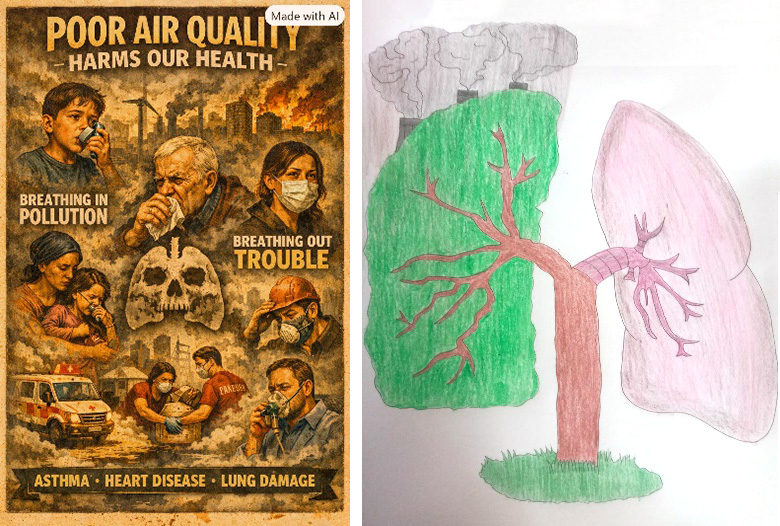
AI-generated artwork on the left and my artwork on the right
What’s to be gained?
When people are partners, not audiences, that means evidence sticks. When a person encounters artwork on social media, or perhaps a poster on a public wall or a market stall, they see themselves. Evidence-based healthcare has always required that we combine evidence with clinical expertise and patient preferences, and when it is harnessed with community input, AI gives us a new chance to do this.
What must we avoid?
It is important to remember that AI alone is blind. And it has biases. This means it is likely to imagine climate-induced health issues as a Western problem. It doesn’t understand the realities people face elsewhere in the world of living in informal housing, walking long distances in the heat, and working regardless of the weather because an income has to be earned. It also cannot reliably produce text outputs in all languages spoken worldwide. So, reliable evidence may remain elusive for many populations who are barred from receiving such information by language barriers and systemic marginalisation. And AI can worsen that problem if we allow it.
Furthermore, many people vulnerable to climate health effects do not have access to smartphones or data. And if AI-enabled health evidence only lives online, they will be left out.
What should we embrace?
Using AI to synthesise ideas and draft how they might look, instead of using it to create final art, enables the art to remain human and held within the community. In this spirit, future artists should be trained to use AI ethically. That is, to check sources, spot bias and keep our stories central.
When I first decided to explore the climate health nexus, I remember having ideas on the topics to address, like poor air quality, but I didn’t know how to represent them using art. I asked AI for ideas on how I could relay my messages and, in that way, I found inspiration, which I worked from.
As this illustrates, there’s a need to acknowledge that we have agency in how we adopt AI. AI is not happening to us.
Take-home messages
- Allow people to author their own health stories: We must integrate AI and community voices. Let’s not just consume AI outputs, but stand as co-creators in this opportunity
- Remember climate health evidence needs art that’s human: A graph of rising temperatures may fail to prompt a mother to move her kiosk to the shade, but a visual illustrating the harsh effects of heat stress might actually work because she’s more likely to see herself in the artwork
- Protect human creativity in evidence-based healthcare: In an age of AI-generated images, fund the health artist, community muralist, and storyteller. They are human resources AI cannot replace
AI tools are powerful, but they have their greatest impact when we work with these tools as partners, because humans and machines can enhance each other’s impact, leading to the strongest evidence-based outcomes.
References
Cleveland Clinic. (2026, May 6). How the heat can affect your heart. https://health.clevelandclinic.org/how-the-heat-can-affect-your-heart
Doctors Without Borders. (2024, May 6). Floods in Kenya raise risk of waterborne diseases. https://www.doctorswithoutborders.org/latest/floods-kenya-raise-risk-waterborne-diseases
Dungan, R. (2024, May 8). Reimagining the future of climate health with AI. Think Global Health. https://www.thinkglobalhealth.org/article/reimagining-future-climate-health-ai
Ge, L., Agrawal, R., Singer, M., Kannapiran, P., De Castro Molina, J. A., Teow, K. L., Yap, C. W., & Abisheganaden, J. A. (2024). Leveraging artificial intelligence to enhance systematic reviews in health research: Advanced tools and challenges. Systematic Reviews, 13, article 269. https://doi.org/10.1186/s13643-024-02682-2
Keleb, A., Abeje, E.T., Daba, C., Endawkie, A., Tsega, Y., Abere, G., Mamaye, Y., & Bezie, A. E. (2025). Floods and waterborne disease risks in Kenya: A public health perspective. BMC Public Health, 25, article 1225. https://link.springer.com/article/10.1186/s12889-025-22382-3
World Health Organization. (2023, October 12). Climate change and health. https://www.who.int/news-room/fact-sheets/detail/climate-change-and-health
World Health Organization. (2025, July 17). The synergies of heat stress and air pollution and its health impacts: Technical brief. https://www.who.int/publications/i/item/B09369
To link to this article - DOI: https://doi.org/10.70253/SLWF2057
Disclaimer
The views expressed in this World EBHC Day Blog, as well as any errors or omissions, are the sole responsibility of the author and do not represent the views of the World EBHC Day Steering Committee, Official Partners or Sponsors; nor does it imply endorsement by the aforementioned parties.