
November 2026
World EBHC Day 2026 Wrap-Up
Global campaign reaches 340.9 million, putting people at the centre of evidence and AI
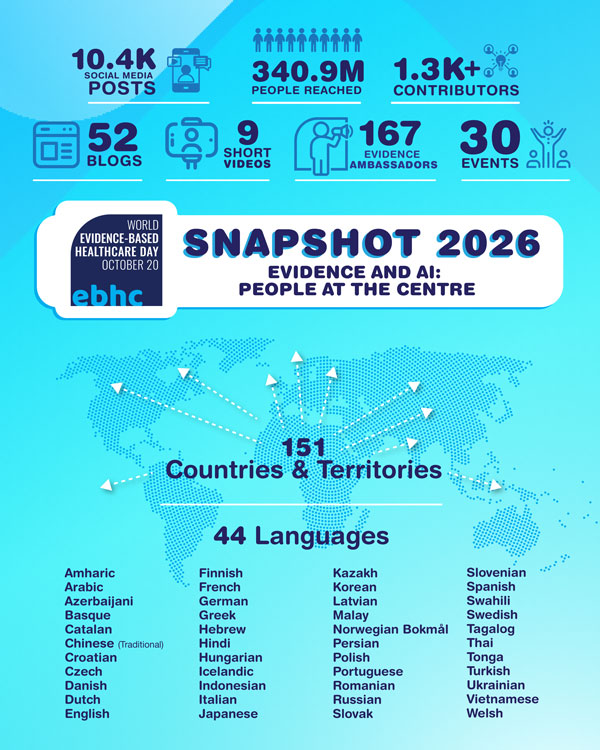
On 20 October 2026, the global evidence community came together for World Evidence-Based Healthcare (EBHC) Day. The campaign, Evidence and AI: People at the Centre, reached 340.9 million people across 151 countries and territories and 44 languages.
Researchers, healthcare professionals, policymakers and communities explored a topic with implications for everyone who produces, shares or uses evidence in healthcare: how can artificial intelligence (AI) strengthen evidence-based healthcare while safeguarding human judgement, equity and public trust?
Evidence and AI: People at the Centre
AI is changing how health evidence is produced, synthesised, communicated and used. From automated evidence synthesis to clinical decision-support tools, it offers possibilities for making trustworthy evidence timelier and more accessible. It also raises difficult but important questions about bias, misinformation, transparency and who benefits.
The 2026 campaign invited people to share their experiences of these changes. Where is AI helping? What needs closer scrutiny? And how can the people affected by these technologies have a say in their development and use?
JBI, Cochrane, Campbell Collaboration, Centre for Evidence Based Health Care, Instituto Veredas, HTAi, GIN and AEYL partnered to deliver the 2026 campaign, which was generously sponsored by Ovid.
Bianca Pilla, Founding Chair of the World EBHC Day Steering Committee, emphasised what is at stake:
"AI is reshaping how evidence is produced, synthesised and communicated. Whether it serves global health equity depends on holding human judgement and public trust at its centre."
A global conversation, shaped by many voices
Approximately 1,300 contributors took part in the campaign, bringing perspectives from research, clinical practice, policy, communication and community.
Across 52 blogs and nine videos, contributors examined AI’s role in evidence-based healthcare and decision-making, the need for AI literacy, and the ethical questions emerging alongside new technologies. Their contributions gave the global evidence community opportunities to learn from one another’s work, experiences and concerns.
The conversation also took place through 30 events worldwide, creating space for discussion, knowledge exchange and collaboration.
A total of 167 Evidence Ambassadors championed the campaign through their organisations, professional networks and communities. On social media, approximately 10,400 posts helped spread the conversation to a wider audience.
What comes next?
The questions raised during World EBHC Day extend well beyond 20 October. As AI becomes part of everyday research and healthcare, decisions about its use will continue to demand scrutiny, discussion and public involvement.
This year’s contributions showed the value of making room for different experiences and perspectives. Understanding what a tool can do is one part of the task. Understanding how it affects people—and whether it meets their needs—requires listening to those who develop it, work with it and receive care informed by it.
Thank you to everyone who contributed, hosted an event, promoted the campaign, shared it with their networks and joined the discussion. Your involvement brought these questions to a global audience and sparked conversations that will continue as AI evolves.
Explore the World EBHC Day 2026 campaign and learn from all the insightful contributions made by the global evidence community.
Founded by JBI in 2020, World EBHC Day is held annually on 20 October to raise awareness of the importance of using the best available evidence to inform health policy, practice and decision-making.