Methodology matters: delivering trustworthy research across the global evidence community
Authors: Melanie Dankel, Mara Lambert
JBI, Faculty of Health and Medical Sciences, The University of Adelaide, Adelaide, SA, Australia
The World Evidence Based Healthcare (EBHC) Day theme for 2024, ‘Health and beyond: from evidence to action’, speaks to the need for healthcare practitioners, researchers and educators to take a global view of health and to consider the multifaceted requirements of different contexts. This theme also asserts that navigating polycrises requires cooperation and collective wisdom from across the evidence ecosystem, and each contributor, including the scholarly publishing community, must bring the best available evidence to the table to help achieve successful outcomes.
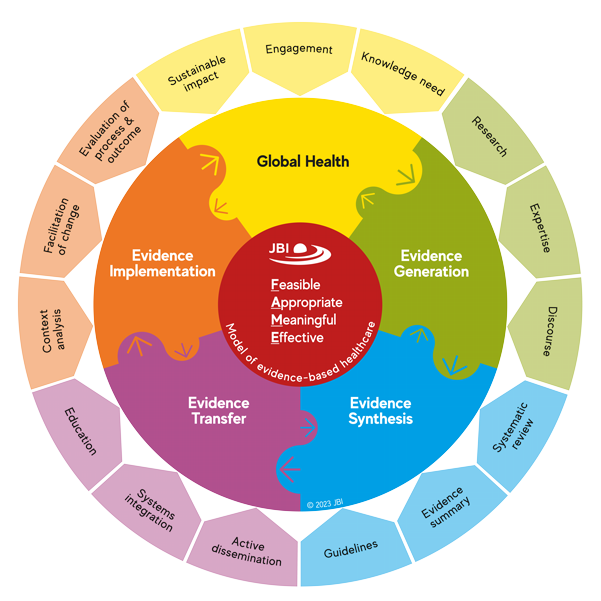
Many within the EBHC community are familiar with JBI and its mission to support the development and delivery of healthcare based on the best available evidence. Following the JBI model of EBHC, evidence must first be generated, then synthesised, transferred and implemented to achieve better health outcomes. As a society journal of JBI, JBI Evidence Synthesis sits within the evidence synthesis section of the model. True to its name, the journal scope is firmly focused on publishing evidence syntheses ‘that directly inform health care practice, policy, and future research conduct’.(para.2) An essential part of this involves presenting ‘high-quality research that provides the best available evidence to inform policy and practice through the science and conduct of systematic and scoping reviews’.(para.1) As with any research, a high-quality evidence synthesis begins with a well-constructed protocol designed to demonstrate the rigour of the research methods and ensure they are reproducible.
A solid methodology should underpin any research that claims to be trustworthy and evidence-based. JBI supports 8 different methodologies for the conduct of evidence syntheses, and these methodologies can be applied to research from a variety of disciplines, not just healthcare. Indeed, there is evidence that multiple industries, including the legal industry, construction, building science/engineering and human resources, turn to JBI methodology to deliver rigorous systematic review methodologies.
As JBI Evidence Synthesis requires authors to adhere to JBI methodology when conducting their research, the journal is committed to publishing papers that support authors’ ability to implement any one of JBI’s different methodologies for evidence synthesis and to help them remain abreast of the latest advances to methods. One avenue for this is through the journal’s article collection dedicated to methodology, with included articles covering a broad range of JBI methodologies, as well as JBI critical appraisal tools, meta-analysis and reporting standards. The journal publishes regular updates to JBI’s methodological approaches, it invites rigorous discussion about JBI tools and methodology and it devotes an issue to methodology each year during Methodology Month.
Working beyond health: the push for inclusion of different populations and contexts
Part of the JBI Model of Evidence-based Healthcare is the consideration of the feasibility, appropriateness, meaningfulness and effectiveness (FAME) of the research, and this applies to more than just healthcare. The approach of the journal considers the support various authors and researchers need to generate, synthesise and present the evidence so that it reaches the widest audience possible.
To align with the FAME framework, there is recognition of the need to deliver the evidence in a format easily accessible to stakeholders. Despite English being ‘considered the lingua franca of scientific communication and publication’,(para.3) there are still many regions where language is a significant barrier to getting the best evidence-based research to the point of care. Since 2023, JBI Evidence Synthesis has published more than 20 systematic and scoping review abstracts in a language other than English, including Finnish, Danish, Chinese, Arabic, French, Japanese, German, Spanish and Norwegian. These abstract translations acknowledge the importance of linguistic diversity and recognise JBI’s reach as a global collaboration. They also serve as an example of how we can use existing technology to respond to the needs of our global community.
Looking at the data by country, visits to the journal’s website in 2023 were still predominantly from English-speaking countries, such as the US and UK, but there was strong engagement from readers in countries such as India, Brazil, The Philippines, China and Portugal. In terms of manuscript submissions, JBI Evidence Synthesis received submissions from 43 countries in 2023, with Canada, Australia and the US strongly represented, but with increasing interest from countries such as India and Brazil, supported by the journal’s continued international focus.
Low- and middle-income countries (LMICs) face sustained disparities in access to health care. Many of these countries also face a disproportionate burden of acute and chronic disease and, due to the epidemiological transition in many LMICs, both communicable and non-communicable diseases. Furthermore, many have a high number of deaths resulting from challenges regarding the effectiveness (or quality) of health care. They are also at greater risk of experiencing the negative effects of a polycrisis.
There is no magic wand that can solve these complex issues in the short term; however, in recognition of the hurdles facing researchers in these countries, JBI Evidence Synthesis has committed to making up to 5 systematic or scoping reviews from LMICs free to access each year in order support research from this region. Since implementing this program in 2020, the journal has yet to reach this limit, further highlighting the barriers inherent in publishing research relevant to the LMIC context. There are a multitude of factors contributing to this; for example, a scoping review by Kaba et al. noted the lack of research mentorship in LMICs compared with high-income countries, further emphasizing ‘institutionalized research mentorship ensures leadership for sustained mentorship in research career development and ensures translations of evidence into policy and practice’.(p.1913)
In addition to this initiative of making systematic and scoping reviews from LMICs free to access, authors from low-income countries (group A) may be eligible for a waiver of the journal’s article page charges for protocols in recognition of those financial barriers to dissemination of research.
Bridging the gap between research and the point of care
Keen readers of the journal will have noted the launch of the inaugural JBI Evidence Synthesis Impact Award for the systematic review with the most potential to improve practice. This award is judged by a group of experts from the JBI Evidence Synthesis editorial panel and considers the review’s relevance, quality, potential for impact, and overall significance. We hope to further draw attention to the important work of our authors and offer exemplars of systematic reviews for future researchers.
While all these initiatives look great on paper, the reality is that they are very small ripples in an ocean of health inequities. JBI Evidence Synthesis embraces its core mandate to disseminate the best available healthcare evidence, and it does so by adhering to the most rigorous standards. But we must look beyond health to the frameworks that support the people who conduct this research and to the health practitioners who must interpret and implement the evidence for the good of their patients.
Ultimately, our work does not exist in a vacuum, and it is this continued surveillance of the landscape and the needs of health practitioners that drives a culture of continuous change and improvement.
Bibliography
Dankel M, Lambert M. Editorial. Abstracts for a wider audience: promoting linguistic diversity in JBI Evidence Synthesis. JBI Evid Synth. 2023;21(5):833-4.
Dawkins B, Renwick C, Ensor T, Shinkins B, Jayne D, Meads D. What factors affect patients’ ability to access healthcare? An overview of systematic reviews. Trop Med Int Health. 2021;26(10):1177-88.
Doi S. Letters to the editor. Bias assessment: mQ or RoB? JBI Evid Synth. 2023;21(6):1344-5.
Gómez-Cabrera A, Gutierrez-Bucheli L, Muñoz S. (2023). Causes of time and cost overruns in construction projects: a scoping review. Int J Construct Manage. 2023;24(10):1107–25.
JBI. JBI methodology month [internet]. JBI; 2022 [cited 2024 Aug 7]. Available from: https://jbi.global/news/article/jbi-methodology-month-0#:~:text=In%20April%2C%20we%20celebrate%20'JBI,making%20and%20evidence%2Dbased%20practice.
JBI. JBI model of EBHC [internet]. JBI; n.d. [cited 2024 Aug 7]. Available from: https://jbi.global/jbi-model-of-EBHC
JBI Evidence Synthesis. About the journal: scope [internet]. JBI; 2024 [cited 2024 Aug 7]. Available from: https://journals.lww.com/jbisrir/Pages/about_the_journal_scope.aspx
JBI Evidence Synthesis. Information for authors: publication fees [internet]. JBI; 2024 [cited 2024 Aug 7]. Available from: https://journals.lww.com/jbisrir/Pages/IFAs_Publication_Fees.aspx
JBI Evidence Synthesis. JBI Evidence Synthesis Impact Award [internet]. JBI; 2024 [cited 2024 Sep 9]. Available from: https://journals.lww.com/jbisrir/Pages/Impact_Award.aspx
JBI Evidence Synthesis. Methodology [internet]. JBI; 2024 [cited 2024 Aug 7]. Available from: https://journals.lww.com/jbisrir/pages/collectiondetails.aspx?TopicalCollectionId=16
Kaba M, Birhanu Z, Fernandez Villalobos NV, Osorio L, Echavarria MI, et al. Health research mentorship in low- and middle-income countries: a scoping review. JBI Evid Synth. 2023;21(10):1912-70.
Law and Justice Foundation of New South Wales. Outreach legal services and complex needs: what works? Justice issues paper 12. Law and Justice Foundation of New South Wales; n.d. [cited 2024 Aug 13]. Available from: https://lawfoundation.net.au/outreach-legal-services-and-complex-needs-what-works-justice-issues-paper-12/
Liu Y, Chiu Y-CJ, Guennouni N, Conyers LM. Career development of college students with disabilities: a scoping review. J Career Dev. 2024;51(2):254-98.
Research4Life. Eligibility for access to Research4Life: Group A [internet]. Research4Life; n.d. [cited 2024 Aug 7]. Available from: https://www.research4life.org/access/eligibility/
Vaughan J, Evans R, Sher W. Embodied carbon inventories for the Australian built environment: a scoping review. Buildings. 2024;14(3):840.
Whiting K, Park H. This is why ‘polycrisis’ is a useful way of looking at the world right now [internet]. World Economic Forum; 2023. Available from: https://www.weforum.org/agenda/2023/03/polycrisis-adam-tooze-historian-explains/
World Health Organization. Noncommunicable diseases. WHO; 2023 [cited 2024 Aug 13]. Available from: https://www.who.int/news-room/fact-sheets/detail/noncommunicable-diseases
World Health Organization. Quality health services [internet]. WHO; 2020 [cited 2024 Aug 7]. Available from: https://www.who.int/news-room/fact-sheets/detail/quality-health-services
To link to this article - DOI: https://doi.org/10.70253/MOVS2419
Disclaimer
Melanie Dankel and Mara Lambert are members of the JBI Evidence Synthesis editorial office. No parts of this blog have been published elsewhere.
The views expressed in this World EBHC Day Blog, as well as any errors or omissions, are the sole responsibility of the author and do not represent the views of the World EBHC Day Steering Committee, Official Partners or Sponsors; nor does it imply endorsement by the aforementioned parties.