Collaborative knowledge communication in action: JBI Thailand’s journey with evidence-based cancer care
Author: Dr Sumuttana Kaewma and A/Professor Adchara Khammathit
Introduction
Each year, World Evidence-Based Healthcare Day highlights the power of evidence to transform health systems and improve lives. The 2025 theme, Collaborative Knowledge Communication, calls attention to how we share our journey, adapt and implement knowledge across contexts. For the JBI Thailand Evidence-Based Healthcare Implementation Center, this year’s theme resonates with our efforts to strengthen cancer care in Thailand and Lao PDR through collaborative, evidence-informed action.
Background
Cancer remains one of the leading causes of death globally, with 19.3 million new cases and 9.9 million deaths reported in 2020. In Thailand, there were 190,000 new cancer cases and 124,000 cancer deaths in 2022, while in Lao PDR, nearly 9,400 new cases and 6,600 deaths were recorded. Despite advances in chemotherapy, side-effects such as nausea, infections and blood disorders often disrupt treatment and compromise patient safety. A key factor behind these complications is the lack of standardised pre-treatment assessments. Without systematic evaluation, healthcare teams may miss underlying risks, leading to higher rates of adverse outcomes and reduced continuity of care.
The problem
In Thailand and Lao PDR, pre-chemotherapy assessments remain inconsistent and unsystematic. Hospitals vary in their approach, depending on available staff and resources. Nurses often lack standardised tools and training, while in Lao PDR, cancer services are still emerging, with many practices relying heavily on physician judgement. This gap results in increased risk of chemotherapy-related complications, delays or interruptions in treatment and patient dissatisfaction with fragmented care. For instance, in one hospital, two patients with similar conditions received different pre-treatment checks simply because staff used different forms—a clear illustration of how inconsistent processes can affect the quality of care.
The search for answers
To address these challenges, the JBI Thailand Evidence-Based Healthcare Implementation Center, located at Boromarajonani College of Nursing Udonthani (BCNU), initiated the project: ‘Impact of implementing evidence-based pre-treatment assessments for cancer patients undergoing chemotherapy in Thailand and Lao PDR.’
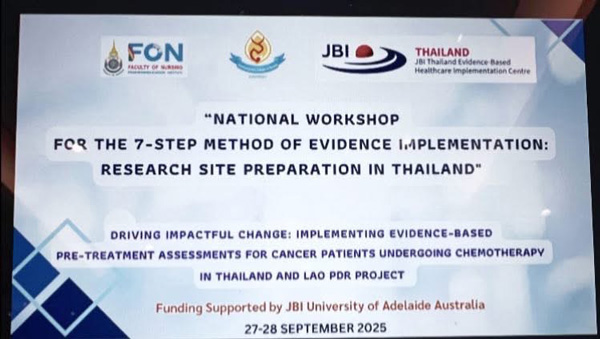
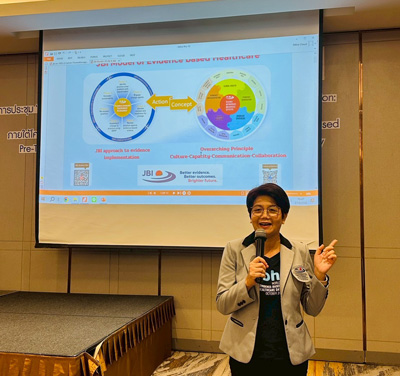
Funded by research grants from JBI and the University of Adelaide in Australia, the study follows the JBI 7-step Evidence Implementation Framework across 13 hospitals in Thailand and 3 in Lao PDR. In September 2025, the project held a workshop to establish the team and prepare the research site at Amari Airport Hotel in Bangkok. This workshop, led by Assistant Professor Adchara Khammathit, a core staff member of JBI Thailand, aimed to introduce PBRI nursing instructors and healthcare provider stakeholders from both countries.
Communication and collaboration were central throughout the process with shared goals, as the participants exchanged insights, clarified local challenges and co-developed strategies to ensure mutual understanding and consistent implementation across sites. The same procedure will be held in Lao at the end of October.
Leadership and commitment
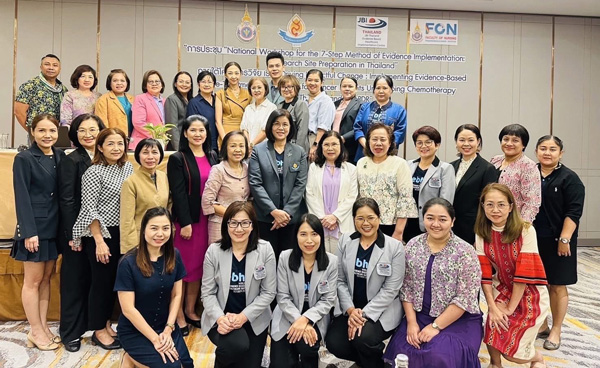
The workshop was formally inaugurated by Assistant Professor Dr. Kamolrat Turner, Dean of the Faculty of Nursing, PBRI, whose participation highlighted the leadership and institutional support that drive evidence-based transformations. In her opening remarks, Assistant Professor Dr. Yupaporn Tirapaiwong, Director of BCNU, emphasised the Center’s expanding influence since it became a JBI-affiliated group in 2019. Professor Tirapaiwong recognised that implementing evidence is not just about introducing new tools or guidelines but about nurturing a collaborative culture, fostering trust and encouraging shared learning. This closely ties with the World EBHC Day 2025 theme, where communication is seen as a reciprocal process: listening, adapting and jointly developing solutions with those directly involved in care.
Results/Outcomes
The workshop marked the first systematic effort to standardise pre-treatment cancer care across Thailand and Lao PDR. Key outcomes included:
1. Building the capacity of frontline nurses and clinicians to conduct evidence-based assessments.
2. Creating a shared cross-border framework to adapt international oncology guidelines (ASCO, ONS, CANO, COSA) to local realities.
3. Strengthening a network of 16 research sites that will audit, implement and monitor change over the next two years.
Early feedback showed strong engagement and readiness among participants, with hospitals reporting enthusiasm to integrate the checklists and sustainability tools into daily practice. As one nurses reflected, ‘We’re proud to join this project and are prepared to use the audit criteria before chemotherapy, because it truly benefits our patients and promotes sustainable nursing care.’
Challenges and lessons learned
Implementing evidence into practice is never without challenges. The project identified key obstacles:
- Resource variation: Hospitals differ in staff availability, training and infrastructure.
- Cultural and contextual differences: What works in Thailand may require adaptation in Lao PDR.
- Sustainability concerns: Maintaining momentum after workshops requires leadership buy-in and ongoing communication.
As one nurse leader from Lao PDR reflected online, ‘This project helped me see that even small communication gaps can lead to big differences in care—but when we share openly, we solve them together.’
Lessons learned so far:
- Excellent articulation of collaborative knowledge communication. One nurse reflected, ‘We learned that open dialogue across borders builds not only skills but shared purpose.’
- Collaboration is essential. Bringing together clinicians, educators and administrators accelerates acceptance.
- Communication must be contextualized. Evidence needs to be translated not only linguistically but also culturally.
- Sustainability must be planned from the start—using tools like the NHS SM ensures evidence-based changes do not fade over time.
Next Steps
Looking ahead, the project will:
1. Conduct baseline and follow-up audits at all 16 research sites.
2. Evaluate changes at 3 and 6 months post-implementation to measure adherence, patient outcomes and sustainability.
3. Share results through regional and international EBHC platforms, ensuring knowledge flows back into the global community.
4. Develop context-specific guidelines that can serve as models for other middle-income countries facing similar cancer care challenges.
These next steps will ensure that knowledge continues to circulate, between hospitals, countries and the wider EBHC community, fostering a continuous cycle of shared learning and improvement.
Key take-home messages
- Evidence saves lives: Pre-treatment assessments reduce chemotherapy risks and improve outcomes.
- Collaboration is power: Cross-country partnerships (Thailand–Lao PDR) amplify the reach of evidence.
- Communication drives change: Evidence must be shared, adapted and contextualised to become meaningful in practice.
- Sustainability matters: Change is not temporary but embedded in healthcare systems.
- World EBHC Day reminds us: Evidence is not just knowledge. It is action, shared through collaborative communication.
We learned that open dialogue across borders builds not only professional skills but also a shared purpose for improving patient care.
References
International Agency for Research on Cancer. (2022). GLOBOCAN 2022: Cancer today — Thailand and Lao People's Democratic Republic. Global Cancer Observatory. World Health Organization
Porritt, K., McArthur, A., Lockwood, C., & Munn, Z. (2023). JBI’s approach to evidence implementation: A 7-phase process model to support and guide getting evidence into practice. JBI Evidence Implementation, 21(1), 3–13
Lai, J., Maher, L., Li, C., Zhou, C., Alelayan, H., Fu, J., & Wu, Y. (2023). Translation and cross-cultural adaptation of the National Health Service Sustainability Model to the Chinese healthcare context. BMC Nursing, 22(1), 124.
Lai, J., Maher, L., Zhou, C., Zhou, Y., Li, C., Fu, J., ... & Wu, Y. (2024). Psychometric testing of the Chinese National Health Service Sustainability Model as an instrument to assess innovation in Chinese nursing settings. International Journal of Nursing Practice, 30(3), e13214.
Stephenson, M. (2025). Evidence summary. Cancer chemotherapy: Pre-treatment patient assessment. The JBI EBP Database, JBI-ES-1882-2.
Sung, H., Ferlay, J., Siegel, R. L., Laversanne, M., Soerjomataram, I., Jemal, A., & Bray, F. (2021). Global cancer statistics 2020: GLOBOCAN estimates of incidence and mortality worldwide for 36 cancers in 185 countries. CA: A Cancer Journal for Clinicians, 71(3), 209–249.
Wu, Y., Li, W., Stephenson, M., Cong, W., & Zhou, C. (2020). Pre-treatment assessment for patients with breast cancer undergoing chemotherapy: A best practice implementation project. JBI Evidence Synthesis, 18(1), 212–223.
To link to this article - DOI: https://doi.org/10.70253/GGAR6517
Disclaimer
The views expressed in this World EBHC Day Blog, as well as any errors or omissions, are the sole responsibility of the author and do not represent the views of the World EBHC Day Steering Committee, Official Partners or Sponsors; nor does it imply endorsement by the aforementioned parties.