Leveraging indigenous knowledge, systems and networks to optimise health insurance adoption in rural Cameroon
Author: Dr Asahngwa Constantine
Cameroon Centre for Evidence-Based Health Care
Introduction
One of the goals of communication in healthcare is to change behaviour. When a change of behaviour is achieved, this is somehow partly considered as success in communication. Conversely, when a change of behaviour is not achieved, this is partly attributed to a failure in communication. Several factors influence the failure or success in communication , including the strategy, the target audience, the object, language and timing. In this blog, I will share my experiences as an anthropologist and one of the facilitators of promoting community uptake of a health insurance scheme using a collaborative knowledge communication strategy in the Fundong Health District of Cameroon.
Background
The Fundong Health District is located in a rural area of the Boyo Division, North West Region of Cameroon. The district is grappling with a plethora of public health challenges, such as infectious diseases, non-communicable diseases, maternal and child mortality, and reproductive health problems. Although the district hosts two faith-based hospital and a public hospital, access to quality health care services at an affordable cost remains a major challenge for the majority of the population. This is due to a variety of reasons, which include poverty, limited financial resources, government policy on out-of-pocket payments and lack of social health protection mechanism (e.g. health insurance or universal health coverage). Most of the inhabitants belong to the Kom ethic community who are indigenous to the locality. This community is predominantly poor and depends on subsistence farming, fishing, livestock raising, hunting and pottery for their livelihoods.
The problem
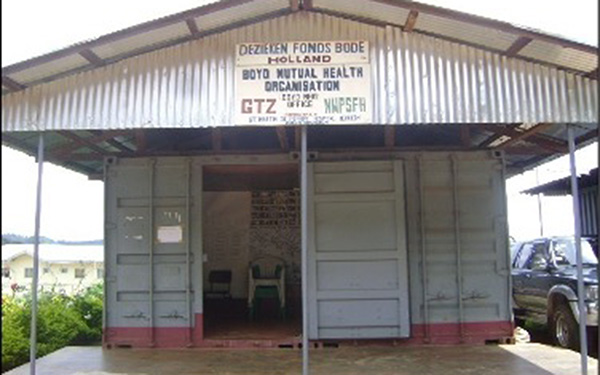
There has been widespread resistance among community members in many parts of the country, including the Fundong Health District, to adopt a health insurance service provided by the Boyo Mutual Health Organisation. The aim of this intervention was to mitigate catastrophic health expenditure and enhance equitable access to health care services for all segments of society. The insurance scheme provides coverage for health care services (e.g. consultation, delivery, hospitalisation, treatment, etc.). based on a co-payment model. This model required members to pay only 20% of the cost while the scheme covered the remaining 80%. Studies conducted in the region identify poor communication of behaviour change messages to community members. The causes that were identified include limited understanding and consideration of the cultural environment by health educators and health insurance program implementers, which led to poor adoption of health insurance services.
The search for answers
The need to conduct a situational analysis to understand the context of the intervention was one of the major outcomes of a brainstorming meeting involving all stakeholders (program managers, GIZ as the technical partner, representatives from the Kom community, local implementation team members and officials from the Ministry of Health). The aim of the meeting was to review the implementation strategy. The situational analysis took place in 2013 and focused on the barriers and motivations for health insurance uptake in the North West Region, including Boyo. However, the analysis did not take into account the cultural dimension of health insurance. Under my supervision, an anthropological study was conducted to understand indigenous knowledge, systems and networks related to indigenous insurance systems in the Fundong Health District. The findings of this study were critical in shaping the implementation strategy, as it informed the project managers and decision-makers on a variety of points that were initially not considered. The findings led to the development of a collaborative communication strategy that later had a positive impact on the intervention’s objectives, as will be shown below.
Result/outcome
The study revealed the existence of an indigenous health insurance system and social networks that operate within the cultural system of the Kom ethnic community. This system operates on a rotative credit system model called ‘njangi’, anchored in a socio-ethnic solidarity network of associations. A ‘njangi’ is an indigenous practice that seeks to obtain reciprocal support and solidarity during difficult periods for members belonging to the same social network. For example, financial contributions are made to support and sustain people in times of sickness or death.
Members of the Kom ethnic community were convened to attend a general assembly using various local communication methods such as community radio and a town crier. During the assembly, the results of the study were presented to the participants using a collaborative communication strategy. The biomedical aspects of the insurance scheme and the indigenous insurance system were jointly explained to community members. Participants of the assembly were representatives of the Kom ethnic group, health insurance implementers, representatives from the Ministry of Health, traditional and religious authorities and the research team. The findings were presented in the local language.
Based on the findings, indigenous social networks were used as platforms to enhance community participation and uptake of the insurance services. For example, several ethnic associations served to pool funds through continuous savings and other fund-raising channels. As a result, a clearer understanding was gained of the indigenous health insurance systems. This knowledge was used to design educational messages to sensitise the population to the importance of enroling into the community health insurance scheme. This process was instrumental in building trust and confidence; it increased community ownership, involvement, participation and acceptance of the services offered by the scheme. This led to increased enrolment of community members in the Boyo Mutual Health Insurance scheme. Thus, by involving the community in the implementation, the initial enrolment figures of less than 200 rose to close to 5,000.
Challenges and lessons learnt
Varied efforts and strategies were used to convince the population to accept joining the scheme. Community members were initially unfamiliar with the culture of the biomedical health insurance model. Furthermore, it was very difficult for community members to understand and internalise the operational logic of biomedical insurance given that the community had low literacy levels. Lastly, it was also challenging to craft linguistically relevant messaging to convey the benefits of the insurance system.
Lessons learnt were that when an external cultural element is introduced within a specific geo-cultural setting, it is critical to consider the existing cultural context of the receiving cultural entity. Furthermore, if you have any intention of changing a behaviour or a system, the first step is to gain a comprehensive understanding of the behaviour or practice you want to change. This is only possible if the behaviour has been systematically studied. The crafting of educational messages is often not informed by systematic research. Consequently, in a case like this intervention project, it becomes ineffective to just pour out massive volumes of biomedical knowledge into a community. This is because emphasis must first be placed on producing deconstructive messages, which are likely to convince the target audience, in this case inhabitants of the Kom ethnic community to change or abandon a particular way of life in favour of another.
Next steps
Fine-tune, enrich and develop this model for scaling into other contexts, contingent on the availability of relevant resources.
Key take-home messages
- A comprehensive understanding of the context where an intervention is needed is critical for achieving the intended goals of behaviour change.
- Indigenous systems, institutions and networks are important tools to enhance trust, build confidence and optimise acceptability to community members regarding an intervention.
- This approach can be relevant in other health -elated interventions given that within the African context and beyond, the co-existence of indigenous medical systems and biomedical systems remains a social reality that should not be ignored.
References
Ministry of Public health, 2016. The Health Sector Strategy (2016-2026).
Asahngwa CT, Odette K, Solange D et al. Hospital Detention for inability to pay: A qualitative study of patient’s experiences. Jour of Surg Research. 2023
Boyo Mutual Health Organization Annual Report, 201O
Boyo Mutual Health Organization Annual Report, 20113
Boyo Mutual Health Organization Annual Report, 2012
Boyo Mutual Health Organization Annual Report, 2013
To link to this article - DOI: https://doi.org/10.70253/GGAR6517
Disclaimer
The views expressed in this World EBHC Day Blog, as well as any errors or omissions, are the sole responsibility of the author and do not represent the views of the World EBHC Day Steering Committee, Official Partners or Sponsors; nor does it imply endorsement by the aforementioned parties.