Looking for information online? Just add evidence!
Looking for information online? Just add evidence!
Author: Zachary Munn
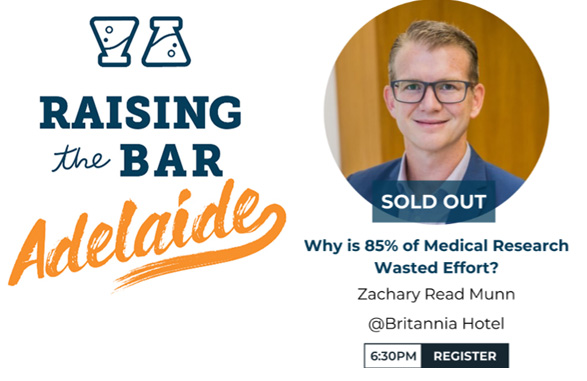
It was a cold winter’s night in Adelaide. At 6pm the traffic was starting to ease after the rush home, and the car park in the pub was full. I managed to find the last free space, grabbed my laptop and rushed into the doors just as the rain started. Many of my friends were already settled in and treating themselves to a schnitzel and a beer. I sheepishly went up to the organisers of the event and apologised for being a little later than expected. Thankfully, Susan and Helen, the two retired volunteers running the show, were gracious and little fazed by my tardiness.
I don’t make it a habit to head to the pub on Tuesday night - in fact, with three young kids and a hectic life I can’t recall the last time I had been out on a ‘school night.’ This, however, was a special occasion as I’d been invited to take part in a science at the pub event as part of the ‘Raising the Bar’ initiative, and I was penned in as the opening speaker for the evening. After apologising again for being a little late (and saying a quick hello to some kind friends and colleagues who had ventured out on a wintery night to support me), I ordered a beer (when in Rome right?) and headed up to the front of the room, ready to start as soon as Helen gave the all-clear. It was my first (and likely only) time I would have a beer during a speech, and given the informal setting, I tried my best to be humorous – and although there were a few awkward silences, most(!?!) of the jokes landed.
The full speech is available elsewhere, but the TL;DR version is that the 40-minute talk was a simple, light-hearted introduction to trustworthy evidence for a pub audience. Inspired by storytelling and the power of the anecdote, I also shared some personal experiences along the way. The key example for demonstrating dodgy health claims throughout the talk was ‘Magicalm’ (and similar products), which are small spray bottles containing trace amounts of magnesium [how much we don’t actually know] that are marketed as a cure-all sleep solution for infants and young children. Claims which seem completely bogus. My advice was to the crowd that when searching up the latest fad, product, supplement, intervention or other type of health claim, simply add the word ‘evidence’ to the search string in google. This drastically changes the results one gets - moving away from miracle cure-alls and product advertisements, to news reports, fact checking articles and similar.
Of course, there are many trusted sites for health advice and information, but these sites can’t hope to cover it all and it can be hard to remember where to look for different types of claims. By simply adding ‘evidence’ to a search string, the search engine often retrieves articles questioning, debating and refuting dodgy health claims. This was certainly the case with the magnesium spray, where one of the first hits was a fact checking article by the ABC. The key takeaway for the public audience was simple – when looking for information about a health claim online, ‘just add evidence.’
I could have quite easily stayed at home during a wet and miserable winter’s evening, but I think it is important for those of us who are passionate about trustworthy evidence to get off our backsides and talk to the public. With the increasing lack of trust in science, all of us in the evidence community cannot keep proselytising to our own echo chambers if we want to truly make a change and promote evidence use in day-to-day life. It is great to see this idea is central to this year’s World Evidence-based Healthcare Day.
As mentioned, the full speech is available here. It also includes a shout out to Adrian Barnett, Paul Glasziou and Doug Altman, amongst others.
This year, for World Evidence-based Health Care Day, I hope we can continue to ‘raise the bar’ for trustworthy evidence and we can all ‘add a little more evidence’ to our lives.
To link to this article - DOI: https://doi.org/10.70253/PRNB1981
Disclaimer
The views expressed in this World EBHC Day Blog, as well as any errors or omissions, are the sole responsibility of the author and do not represent the views of the World EBHC Day Steering Committee, Official Partners or Sponsors; nor does it imply endorsement by the aforementioned parties.