Producing and sharing knowledge about alcohol-related harms with Nepali communities
Author: Helen Kara
Introduction
This blog summarises some recent research into alcohol-related harms in a Nepali city which was co-created by UK and Nepali academics and local Nepali communities and organisations (Luxion et al, 2025). Nepal has a high level of alcohol-related harm, particularly among men, which leads to poorer health outcomes. These are likely to deteriorate further as rates of alcohol consumption in Nepal are increasing. However, there has been little research into alcohol use in Nepal. Furthermore, existing policy recommendations are not culturally informed and so do not offer meaningful engagement with Nepali people’s lives.
A knowledge exchange partnership was set up to gain an understanding of alcohol use in Nepal and work towards more effective recommendations through the Alcohol Co-Design and Community Engagement (ACE) study. This partnership includes University College London, the World Health Organisation, diverse local communities from Lalitpur city in Nepal (also known as Patan), and local creative and health organisations. The partnership was determined to put indigenous knowledge on an equal footing with Eurocentric knowledge, and to take a wide and equitable view of ‘evidence’ as including Nepali texts and cultural assets alongside English texts. To make this happen, a team of co-researchers was established, made up of academics in the UK and Nepal, and community and organisational partners in Lalitpur, including policy makers and people with lived experience. Academics came from public health and other social science and arts disciplines. Local community colleagues were regarded as contributing equally to academic colleagues in the generation and synthesis of knowledge.
The co-researchers decided to use a series of creative methods within a participatory framework, including immersive walking as a process of sensory ethnography, a critical realist review, co-researcher workshops, and a community festival.
Immersive walking
Immersive walking served both to generate new knowledge and to reflect on co-researchers’ existing knowledges of Lalitpur. The walks focused on spaces where people gathered, such as temples, markets, and cafés, where the co-researchers could see alcohol-related behaviours and identify community resources. Co-researchers wrote and drew diary entries and recorded photographs and video, which were then shared and discussed in weekly team meetings. These meetings generated shared knowledge which was implemented through the planning and execution of the other study activities.
Critical realist review
The critical realist review (CRR) is an established empirical method, but the co-researchers took a creative approach by widening their definition of ‘literature’ to include not only empirical literature published in English or Nepali, but also cultural assets, policy documents, and artefacts from the immersive walking, creative workshops and community festival. This approach was inspired by the work of Edgley et al (2016). The CRR was conducted concurrently with the other activities, and the method regularly reviewed and updated in the weekly team meetings to incorporate new knowledge as it was generated. In practice this meant that over time, new search terms and local organisations were added, and the inclusion/exclusion criteria were clarified and more tightly focused.
Creative workshops
The study team conducted three half-day workshops for co-researchers. The first was held in a training hall in Lalitpur in January 2024. For most of the co-researchers, this was the first time they had participated in creative activities to explore public health issues, so the workshop was facilitated by team members with more experience. The co-researchers were split into two groups: one to assess existing alcohol-related resources and services in Nepal, and the other to consider services and initiatives that were needed but not currently available. These topics were explored and ideas generated using creative activities including drawing, writing, collaging and painting. The generated ideas were synthesized to form recommendations for future development of alcohol-related services in Nepal.
The second and third workshops were held at a community centre in March and July 2024. The second workshop explored local understandings of alcohol-related harms, support needs, community assets, and how local communities could influence government policy on alcohol. Community co-researchers suggested forming two groups by gender in this workshop, to enable more comfortable and open discussions. After this workshop, the study team reviewed the work done to date through immersive walking, work on the CRR, and the first two workshops, and identified four key themes for the study:
1. Diverse experiences and consequences of alcohol use
2. Alcohol-related stigma in Nepali society
3. Cultural assets and resources communities possess to reduce alcohol harm
4. External support required to reduce alcohol harm and promote health
The third workshop was designed to expand on these themes, with four groups of co-researchers, one to consider each theme. Each group was supported by an artist-researcher from the study team, and they used drawing, painting, collaging and model-making in their investigations. People in this workshop also spent some time planning the forthcoming community festival.
Community festival
This was a two-day event in August 2024 held at a local community centre with outdoor space within a historic square. The aim was to share knowledge from the study, invite more local people to become co-researchers, and expand the four key themes. In Euro-Western academic terms, it would have been called a ‘dissemination conference’, but this terminology is not common in Nepal where festivals are a regular occurrence. Locally based artist-researchers led four ‘art workstations’, each focusing on one of the four themes, and offering painting, drawing by hand, computer drawing, model-making, and clay work with two potters’ wheels. There was also an exhibition of photos taken by co-researchers during immersive walking, talks and discussions about alcohol, presentations of findings to date from the CRR, and generation of ideas for ways to reduce alcohol harm and future research on the topic.
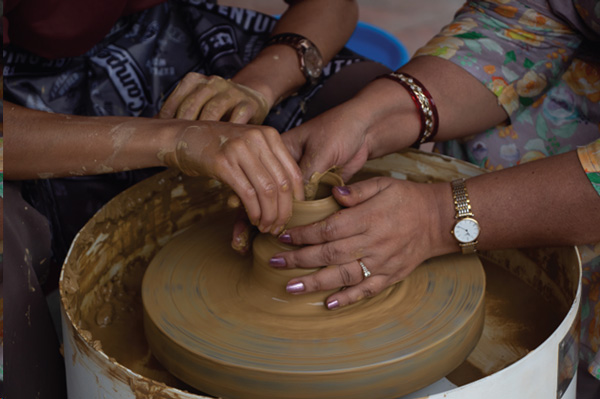
Photo reproduced unaltered from Luxion, K., Acharya, A., Chang, S., Williams, N., Allen, K. and Dhital, R. (2025) Shaking the foundations: co-creating knowledge exchange to inform alcohol research, policy, and practice in Nepal. Journal of Creative Research Methods 1(1) p 86.
The festival was attended by around 200 local community members and people from local organisations. People who participated in arts activities were invited to take their artworks home. The event itself, and in particular the creative activities, generated excitement and positive feelings, in contrast to the stigma around alcohol in Nepal.
Dissemination
This is being done through conventional academic journal articles (forthcoming, apart from the one summarised here) and also blog posts written by the artist-researchers who facilitated the four art workstations at the community festival. These blog posts enable quicker and wider knowledge sharing than academic journal articles, and also support more public engagement. Aishwarya Manandhar and Binu Rai wrote about the cross-cultural learning at the festival, and about how creative practices can be used to challenge stigma. Kripa Tuladhar wrote about the powerful role of art in communicating about topics that are difficult to discuss because of social taboos. And Rahul Maharjan acknowledged the cultural importance of alcohol for some communities in Nepal.
I was not part of the study team for this research, but I was delighted that the article on which this blog is based was accepted for publication in the first issue of the new Journal of Creative Research Methods (JCRM). I co-founded this journal with Bristol University Press and we launched it at the International Creative Research Methods Conference in September 2025. The whole of the first issue is free to download until 31 December 2025. JCRM is intended as a vehicle for sharing information about creative research methods and their role in collaborative knowledge communication across disciplines and sectors, and we welcome submissions in either conventional or creative formats.
Key messages
Creative research methods are useful in enabling and supporting people’s discussion and consideration of difficult and taboo topics.
Co-research with local communities can lead to more culturally sensitive, effective, and implementable policy recommendations.
There is now a journal dedicated to publishing accounts of creative research in conventional and creative formats.
References
Luxion, K., Acharya, A., Chang, S., Williams, N., Allen, K. and Dhital, R. (2025) Shaking the foundations: co-creating knowledge exchange to inform alcohol research, policy, and practice in Nepal. Journal of Creative Research Methods 1(1) 72-96. https://doi.org/10.1332/30502969Y2025D000000008
Edgley, A., Stickley, T., Timmons, S. and Meal, A. (2016) Critical realist review: exploring the real, beyond the empirical. Journal of Further and Higher Education, 40(3) 316–30. https://doi.org/10.1080/0309877x.2014.953458
Manandhar, A. (2024) Patan community festival artist spotlight. Creative Health Nepal blog, 20 September. https://medium.com/@creativenepal/patan-community-festival-artist-spotlight-aishwarya-manandhar-5b52487de6fc
Rai, B. (2024) Patan community festival artist spotlight. Creative Health Nepal blog, 20 September. https://medium.com/@creativenepal/patan-community-festival-artist-spotlight-binu-rai-3e0173374bea
Tuladhar, K. (2024) Patan community festival artist spotlight. Creative Health Nepal blog, 20 September. https://medium.com/@creativenepal/patan-community-festival-artist-spotlight-kripa-tuladhar-96fe85389dd2
Maharjan, R. (2024) Patan community festival artist spotlight. Creative Health Nepal blog, 20 September. https://medium.com/@creativenepal/patan-community-festival-artist-spotlight-rahul-maharjan-a526029b9a57
To link to this article - DOI: https://doi.org/10.70253/VSUW4600
Disclaimer
The views expressed in this World EBHC Day Blog, as well as any errors or omissions, are the sole responsibility of the author and do not represent the views of the World EBHC Day Steering Committee, Official Partners or Sponsors; nor does it imply endorsement by the aforementioned parties.