Ubuntu evidence: All of us
Authors: Jumwoh Miguel, Nange Lisette and Ayafor Leonel
Storytellers at eBASE Africa
Introduction
In the evidence world, knowledge is no longer hidden within a particular structure, and organisations no longer work under separate philosophies. However, a growing lack of information, coupled with disinformation, create disunity among the same people who were meant to transfer this knowledge. In the face of such challenges, entities need to come together and pool their resources to improve livelihoods through Collaborative Knowledge Communication. When knowledge is shared through collaborative means, it not only enhances decision-making and productivity, but also mirrors the Ubuntu evidence philosophy.
What is Ubuntu?
Ubuntu means ‘I am because we are’. The philosophy helps us to see ourselves through each other’s experiences. It is an indigenous African concept that upholds collectivism and not individualism. It sees the self as a product of the community.

Through Ubuntu, we can only gain our true power by sharing ourselves. It sees the self as a product of the community. Ubuntu is practised in African cultures, valuing the collective sharing of ideas and experiences for the benefit of the broader community. This philosophy is centred on the idea of our humanness. A human is a product of the community that has shaped their personality over the years. So, when we accept and share our humanness with our community, we turn to reflect each other’s identity in the things that we do, say and envision.
This philosophy is closely tied to collaborative knowledge communication because for people to collaborate, they first need to see aspects of themselves in each other, they must respect each other’s values and ways of seeing the world. The Ubuntu philosophy is one of the core factors that grounds the Tori Dey concept at eBASE AFRICA, helping the organisation to see itself through a community lens as it uses participatory observation to integrate the community into the evidence world.
The Challenge of Sharing Knowledge
In this age of rapidly growing availability of data, the ability to share knowledge seems to be an undeniable tool for improving livelihoods. Over the years, the approach has moved beyond telling stories to building the capacity of local storytellers and collaboratively sharing experiences through the Tori Dey approach across Africa. The approach aims to ensure that community values are respected and contextually understood to facilitate acceptance, understanding and maintenance of the information being shared.
The problem
Research is rich in data, but this data is hidden behind cultural values and scientific jargon. The people who would benefit from this data are unable to do so, thereby wasting the precious resources and hard work of researchers. Thus, they continue to suffer as a result of misinformation or the lack of information, and so the data is rendered useless. Institutions and organisations that communicate knowledge are called upon to embrace the Ubuntu philosophy to synthesise their knowledge communication approaches and build a network of evidence-based communicators. This network will ensure the smooth flow and implementation of data within the various communities it was intended to serve.
Tori Dey: The Solution in Practice
Tori Dey began as an experiment where two rivers met—the river of scientific evidence and the river of indigenous knowledge (The Comings of Two Rivers). When art and science flowed together, evidence became relatable and community members became active participants rather than passive audiences. Rooted in the Ubuntu philosophy at eBASE Africa, the belief is that science is an art and vice versa. Thus, the coming of these two rivers is an obligation, and not a matter of choice.
Through songs, drama, and paintings, the rigorous and systematic approach enables grassroots storytellers and researchers to co-create and bridge the gap between scientific knowledge and communities. In this way, scientific evidence is translated in a simple yet systematic way that is engaging and interactive, culturally relevant, and accessible. These stories resonate with communities through inclusive, participatory communication. This allows marginalised voices to also share in the evidence, by bringing their indigenous knowledge systems into the narratives.
The Tori Day method eliminates barriers to translating evidence through language that people will understand. Tori Dey narratives resonate with community members by using familiar cultural forms. The method follows a structured, seven-step process and theoretical frameworks. This approach includes a continuous cycle of actively engaging the community, ensuring that the results lead to tangible behaviour change. In this way, the method is aligned with the transtheoretical model of behaviour change (Prochaska & DiClemente, 1983).
The Tori Dey Circle
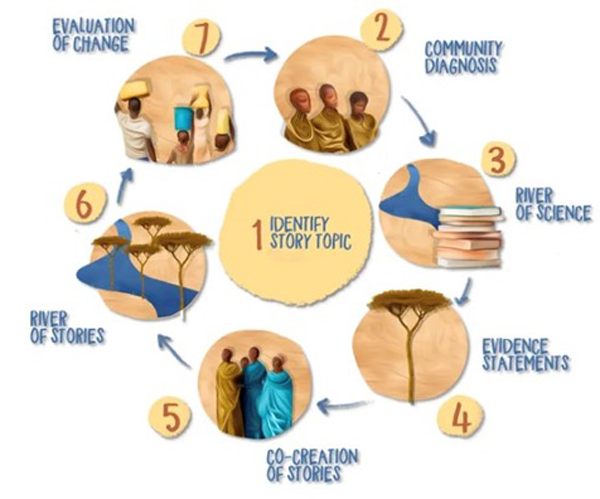
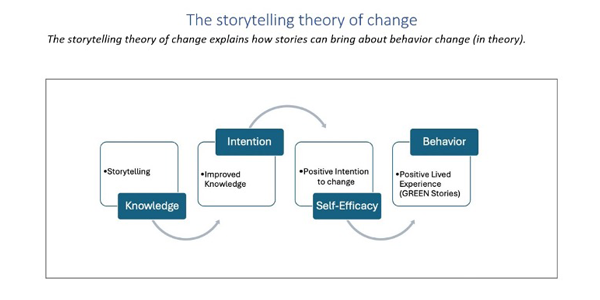
Putting Ubuntu into Practice:
The Story of Bebitzem
Once upon a time in a village called Bebitzem (all of us), the people lived together, hunted together, farmed together and ate together, since hunting and farming for artemisia was their main source of livelihood. But there came a time when competition grew amongst them, bringing disunity and conflict. This situation led to a scarcity of meat. Tah Alan, a member of the community and a hunter himself, complained that one hand cannot tie a bundle, referring to the scarcity of artemisia due to fewer farming groups and abandoned animals in the forest. This was because the hunters couldn’t bring the animals back home alone. He continued, ‘From the day we lost our spirit of communalism hunters have become the hunted. Some see very big animals and run. Parents now have to travel to neighbouring villages to buy artemisia for their sick children, leading to a health and economic crisis.
Worried about this situation and reflecting on the stories his grandfather used to tell him around the fire about the source of their strength, the I am because we are. From that moment, Tah Alan gathered all the community hunters and farmers in the market square under a tree. He invited the chief priest and seers (storytellers) and through songs, drama and paintings, the Bebitzem community was reminded of their strengths and cultural values.
On the next community hunting day, all the hunters in the community come out in force. Farming groups for the cultivation of artemisia reunited and together as one, they respected their community principle of I am because we are. Bebitzem now flourished with meat, artemisia and good health.
Result/outcome
The work includes storytelling and other African Indigenous approaches for participative evaluation in Cameroon. This was presented at The Transforming Evidence Network (TEN) Conference - Nov 19-21, 2024.
Challenges
Funding has limited the ability to promote the vision of the Ubuntu evidence communication network. Another challenge relates to language barriers, as research evidence is dominated by the English language, often requiring translation of evidence into the local languages of the communities.
Lessons learned
The greatest lesson learned in this journey is that you cannot tell a story to people you don't know. Tori Dey has helped the organisation to experience the power of I am because we are (Ubuntu).
Key take-home messages
The concept of Ubuntu is a concept that can be applied to every aspect of life. As knowledge communicators, we must embrace the spirit of, I am because we are as a network of knowledge capacity-builders. Knowledge-sharing becomes a community role, as every member of the community will see themselves through the mirror of ubuntu in evidence
References
Okwen P, Lisette N, Ayafor L. The Comings of the Two Rivers: Storytelling Science Data [Internet]. EvalParticipativa; 2024 [cited 2025 Oct 6]. Available from: https://evalparticipativa.net/en/2024/02/13/the-comings-of-the-two-rivers-storytelling-science-data/
Ayafor L . The Strength of the Stage: Tori Dey at the Heart of Scientific Conferences [Internet]. [cited 2025 Oct 6]. Available from: https://ebaseafrica.org/blog/the-strength-of-the-stage--tori-dey-at-the-heart-o
Links to additional resources
AFRICAN EVIDENCE NETWORK , USHAHIDI WA HADITHI ,THE COMINGS OF THE TWO RIVERS, STRENGTH OF THE STAGE,TORI DEY, TORI DEY CIRCLE, STORYTELLING AND PARTICIPATORY EVALUATION RETREAT, STORYTELLING, MIRRORING THE COMMUNITY
To link to this article - DOI: https://doi.org/10.70253/WKUB7053
Disclaimer
The views expressed in this World EBHC Day Blog, as well as any errors or omissions, are the sole responsibility of the author and do not represent the views of the World EBHC Day Steering Committee, Official Partners or Sponsors; nor does it imply endorsement by the aforementioned parties.